
Read Marshall Property Tax Records
Marshall County property tax records tie together two things. One is the Revenue Commissioner's appraisal and assessment work. The other is the bill that follows each year. Read them with the numbers kept separate. Appraised value, assessed value, exemptions, total tax, and any balance due each answer a different question. The owner of record and the billing year deserve dates too. A recent transfer may not have reached every system yet. An older label is not always a stale one.
| Field | What It Shows | Where |
|---|---|---|
| Appraised value | County estimate of fair-market value | Revenue assessment |
| Assessed value | Appraised value after class ratio | Revenue assessment |
| Exemptions | Eligible reduction to taxable base | Revenue assessment |
| Total tax and balance | Year-specific charge and amount shown due | Property portal |
| District | City, county, school, or special millage | Revenue rate schedules |
Most owner-occupied homes and farm land in Marshall County fall under Alabama Class III, which applies a 10 percent assessment ratio. Exemptions can then shrink the taxable base further. Neither figure tells you what a buyer would pay for the property.
Marshall Tax Portal Search Modes
The county portal offers several ways in: Name, Company, PIN, Parcel, Account, Subdivision, and Address, plus a tax-year selector. Address mode splits street number from street name. Every result line lays out Description, Account, Parcel, Year, Billing Year, PIN, Total Tax, and Balance Due.
| Portal field | Tax use | Caution |
|---|---|---|
| Year and Billing Year | Date the row | Not deed date |
| Total Tax | Charge shown | Not appraised value |
| Balance Due | Displayed unpaid amount | Confirm live |
| Account, Parcel, PIN | Match county records | Keep each label |
The portal sometimes shows temporary conditions, such as a default tax year or a message about disabled payments during maintenance. Treat those as passing states rather than standing rules for Marshall County tax bills.
Marshall's October-to-May Calendar
Marshall County collects property tax on a fixed yearly cycle. Bills come due October 1 and stay timely through December 31. Miss that window and interest begins January 1. The county stops accepting checks for delinquent payments after February 28. Traceable notices follow in March. The tax-lien auction then lands on the first Tuesday in May.
Marshall Homestead Classes H1-H4
Homestead relief in Marshall County comes in four flavors. The Revenue exemption guidance lays out classes H1 through H4. H1 covers the standard owner-occupied homestead. The others turn on age, disability, income, or total disability. Each has its own proof requirements and annual-renewal rules. Check current county criteria before applying. An exemption lowers taxable value without changing the owner of record on the deed.
Marshall Improvements Can Lag
New construction moves slowly through the tax roll in Marshall County. Revenue asks that improvements be reported after October 1. Reaching the roll can then take up to two years. A buyer may even get a bill still bearing the prior owner's name. So the tax year, the improvement date, and the deed recording date are three separate facts. They are worth telling apart. Keep permit evidence, photos, deed references, and the dated Revenue record handy. A stale entry can muddy the picture.
Marshall Millage Depends on District
Millage in Marshall County varies by where the parcel sits. The county publishes separate schedules for Albertville, Arab, Boaz, Guntersville, and rural areas. One mill means one dollar of tax per thousand dollars of taxable value. City, county, school, and special levies stack together. They can produce very different bills from the same assessed amount. A mailing city or ZIP line will not settle the question. Confirm the parcel's jurisdiction and the rate schedule for that tax year.
Marshall Annual Abstracts Since 1998
The Revenue office publishes annual abstracts. They cover assessments, exemptions, and ad valorem tax totals for every year from 1998 through 2025. These are county-wide summaries. They show how Marshall County's tax base has moved over nearly three decades, which helps when you want context for a single account's changing valuation. An abstract cannot substitute for the parcel-level tax roll, though. It never drills down to one parcel number.
A separate item comes from fiscal-year 2024-25 closed bids. Those records list a Revenue Commissioner document-scanning procurement. A scanning contract proves only that digitization was purchased. It does not prove the work finished or that a new public portal went live. Treat online coverage of older Marshall County property records with that limit in mind rather than assuming it grew.
Look Up a Marshall Tax Bill
Start with an address or a labeled parcel identifier. Pick the right tax year before opening an account, and compare the property description against what you expect. Only then read the charge and balance fields. A name search works better when a single owner of record holds several Marshall County accounts.
- Open the county portal and choose the tax year.
- Search by address, account, parcel, PIN, owner, company, or subdivision.
- Match Description and identifiers before reading Total Tax and Balance Due.
- Confirm exemptions, district, delinquency, and payment route with Revenue.
- Assessed value
- Appraised value after the class ratio.
- Mill rate
- Tax dollars per thousand dollars of taxable value.
- Homestead exemption
- Qualified relief that reduces the taxable base.
- Tax lien
- A claim arising from unpaid property tax.
See Marshall's Tax Search
The official county tax portal shows the tax-year selector and its distinct search modes up front, so you can choose an approach before any account opens.
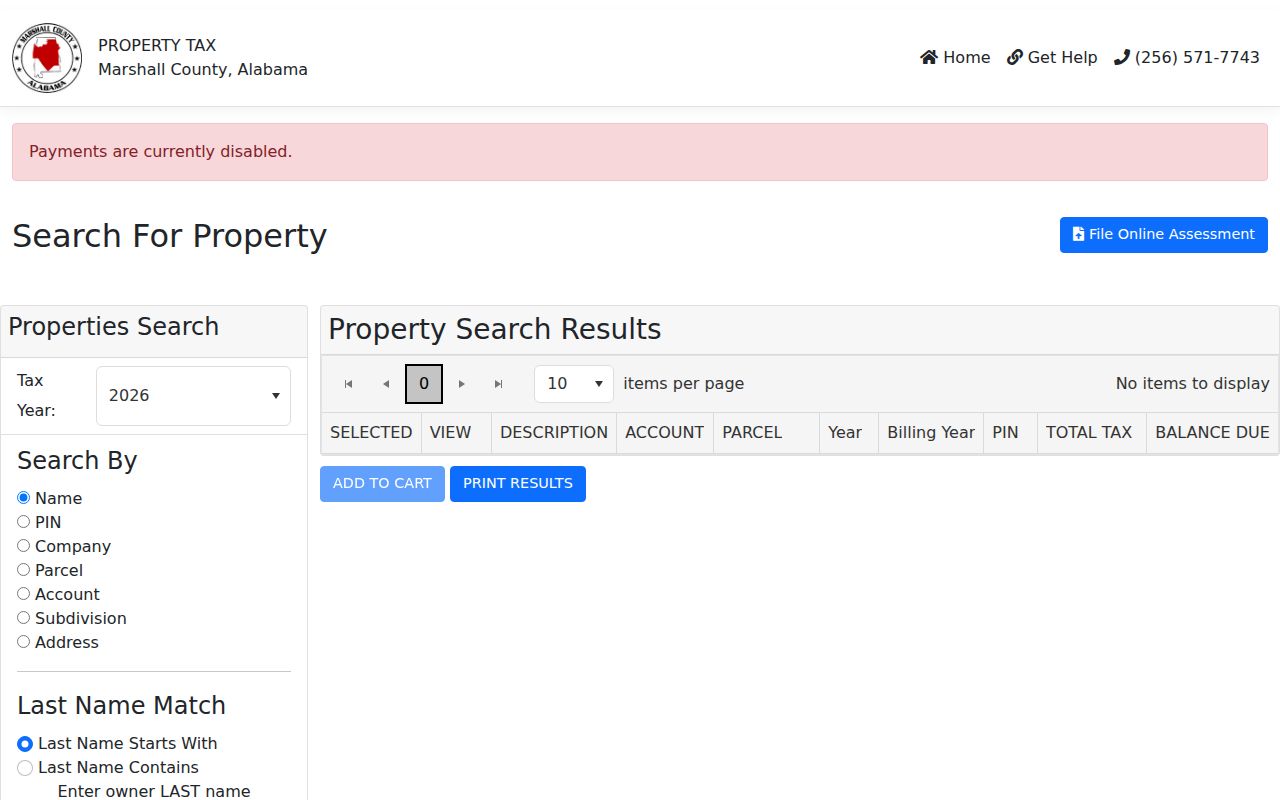
The same official search page lays out the path to year-specific tax records. Match the property description and labeled identifiers first. Trust a charge or balance only after those line up.
Marshall Tax Bills Can Name Prior Owners
Revenue offers a caution for new owners. A Marshall County tax bill can still list the previous owner of record. That bill is not junk mail. It still demands payment on schedule. Bring the parcel number and account details to Revenue. Check the latest deed on file in Probate, and ask how the ownership correction will affect the current billing cycle before you pay or appeal anything.
A name mismatch is a timing problem, not evidence that the deed failed to record. Keep a simple paper trail instead: the deed recording date, the tax year, and the date you contacted Revenue. That way every statement stays tied to its source.
Marshall Manufactured Home Records
Marshall County property tax records treat manufactured homes as their own assessment subject. The county's guidance spells out what owners must do. A home and the land under it may carry different identifiers. They may even have different owners of record. One tax bill, in other words, does not always cover both interests.
Ask Revenue which account applies. Ask also whether the home is assessed as real or personal property under the current facts. The recorded land deed controls only the interest it actually conveys. Read it no further than that.
Contest a Marshall Assessment
Marshall County publishes no single appeal deadline you can count on. The Revenue Commissioner sets the review calendar each year. Call the office promptly after your assessment notice arrives and ask for the current review steps and the Board of Equalization schedule. Evidence wins appeals. Keep the notice date and parcel number together with photos, permits, and comparable sales. The appeal targets the assessment itself, not the recorded deed. Ownership and boundary questions follow a separate track. Two Revenue offices serve the county: 424 Blount Avenue, Suite 124, in Guntersville and 412 Martling Road in Albertville. Tax Assessors can be reached at 256-571-7753. Confirm which office handles your parcel before you drive over. Ask whether an appointment, a form, or original proof is required, and write down the answer, the call date, and any filing instructions so they sit alongside the assessment notice.
The county also publishes property-tax guidance on current-use treatment and manufactured homes. Current use values eligible land by its qualifying use rather than a general fair-market approach, subject to application and continuation rules the county administers. Manufactured homes need separate attention. The home and the land may not share one owner or one account. Ask Revenue which record controls each item. Never assume one parcel result covers both items. Annual abstracts add countywide context. Marshall County posts assessment, exemption, and ad valorem summaries covering 1998 through 2025. They show how totals and exemptions changed. They cannot explain one parcel's assessment. For an appeal, rely on the parcel's current property facts, the notice, the county's classification and exemption rules, and timely instructions from Revenue. A countywide trend never replaces evidence about your property.
Tax district is another parcel-level fact worth confirming. Marshall County's published millage schedules distinguish Albertville, Arab, Boaz, Guntersville, and rural rates. Postal city names cross municipal lines. Match the account to its taxing district before calculating the effect of any assessed-value change. Exemptions need their own evidence. The county's H1 through H4 guidance separates the standard owner-occupied homestead from categories tied to age, income, disability, or total disability. Some relief requires proof or annual renewal. A deed proves ownership, not every exemption condition, and an exemption entry does not establish marketable title either. File the application, supporting proof, approval or denial, assessment year, and current account result together, and call Revenue before relying on an older eligibility summary because state thresholds and local procedures can change.
Delinquent-tax research rewards careful dating. October 1 is the due date. The timely period closes December 31, and January 1 starts delinquency and interest, followed by the county's later notice and auction steps. Confirm the live account and its legal status before drawing any conclusions. An advertised lien, an unpaid balance, and an ownership transfer are three different events. The Revenue account supplies the tax status for the parcel. Probate land records supply recorded conveyances and releases. Neither source alone can prove that a parcel changed hands.
Appeal window. Confirm the current filing window with Marshall Revenue as soon as an assessment notice arrives; the inspected sources did not verify a fixed date.