
Read Marshall County Deed Records
The Judge of Probate handles recording for Marshall County. The office sits in Guntersville and serves as the recording office for Marshall County deed records. Every deed names a grantor who conveys an interest and a grantee who takes it. The instrument also carries a legal description and a recording reference. Recording gives public notice. It never guarantees that title was clear or that no unrecorded interest exists.
| Deed Type | What It Does | Common Use |
|---|---|---|
| Warranty deed | Transfers with stated warranties | Conventional conveyance |
| Quitclaim deed | Transfers whatever interest exists | Family or corrective transfer |
| Personal representative deed | Conveys through an estate | Estate administration |
| Correction deed | Corrects an earlier instrument | Name or description issue |
| Release or assignment | Changes a recorded interest | Mortgage or lien trail |
Mortgages, assignments, and releases are related branches rather than the transfer itself. Read them as part of the wider record trail. Marshall requires a value slip from Revenue before recording, which links conveyance and assessment work without turning the tax value into a sale appraisal.
Marshall's 1990 Online Window
The Land Title Association of Alabama lists online Marshall land records from 1990 to current. Anything earlier lives in deed books, direct and reverse indexes, and microfilm. FamilySearch's Alabama wills and deeds collection and Valley Leaves transcriptions can surface an older reference, but confirm each lead against the official book before trusting it.
Marshall Probate Search Controls
The Probate portal gathers land-record lookup, probate cases, account access, R.E.A.A.C.T., instructions, and terms in one place. Its platform instructions cover Grantor, Grantee, Assignee, instrument type, date range, and starts-with matching.
| Control | Meaning | Use |
|---|---|---|
| Grantor | Transferor | Find deeds out |
| Grantee | Recipient | Find acquisitions |
| Assignee | Assigned-interest recipient | Trace mortgage branches |
| Instrument type | Document category | Separate deeds and releases |
| Date range | Recording window | Narrow common names |
Note: Search the indexes manually and record the exact deed reference you find.
Marshall Fees and Correction Returns
Marshall's recording sheet sets fees plainly. The first page costs $16.50, and each added page costs $3. Deed tax runs $0.50 per $500 or fraction. Mortgage tax is $0.15 per $100 or fraction. Indexing beyond two grantors and two grantees adds $1 per name. Confirm the total before you file anything. About 20 percent of submissions come back for correction or a wrong fee. Originals average roughly two days to return. So a missing recent deed may mean rejection, correction, or indexing delay. That does not mean no transfer at all.
Free Marshall Deed Alerts
R.E.A.A.C.T. is free. It sends notice when a registered name matches new county real-estate activity. It accepts name variants, though common names can trigger false matches. Coverage stops at the Marshall County line. Treat each alert as a prompt to check official deed records. The service blocks nothing and replaces no title insurance. Suspected fraud belongs with Probate, and with the Sheriff or an attorney when warranted.
Walk Marshall's Grantor-Grantee Index
A chain of title is the linked sequence of transfers. It covers one piece of land. Start with the most recent acquisition. Then search that grantor as an earlier grantee, and keep going back. Hold the legal description and the book/page or instrument reference together as you move.
- Find the present acquisition with the owner as grantee.
- Read the grantor, land description, date, and reference.
- Search that grantor as an earlier grantee and match the same tract.
- At the online cutoff, continue in books and older indexes.
- Grantor
- The party transferring an interest.
- Grantee
- The party receiving an interest.
- Chain of title
- The ordered sequence of recorded transfers.
- Book/page or instrument number
- The reference used to retrieve a recording.
See Marshall's Probate Gateway
The Marshall Probate gateway routes visitors to land records, probate cases, account access, instructions, terms, and R.E.A.A.C.T.
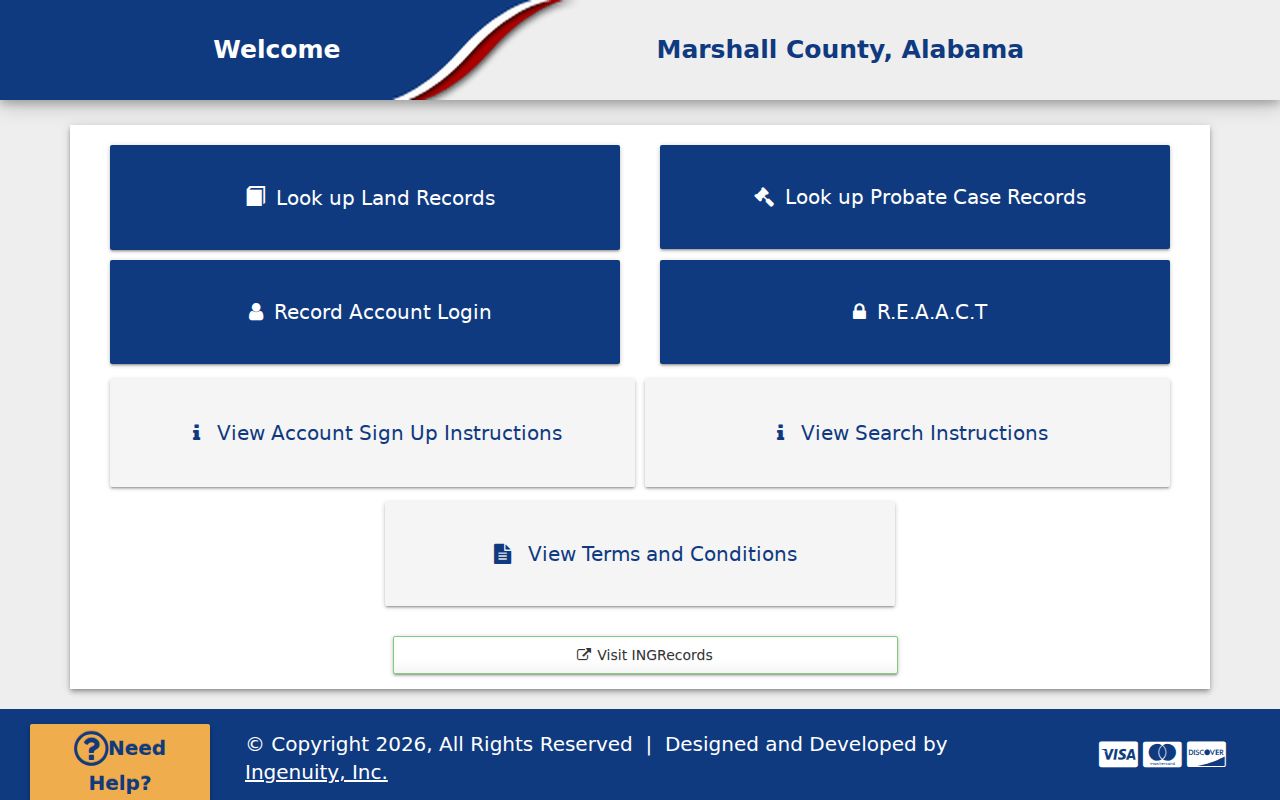
The official page lays out the routes without showing a named instrument. Pick land records for a deed chain. Open probate cases only when estate administration matters to your search.
Book and Page Preserve the Trail
A book/page or instrument number beats a copied owner name, because it points back to one recorded item and nothing else. Write that reference beside the legal description, recording date, instrument type, grantor, and grantee. When a correction deed shows up, keep both the corrective document and the earlier reference. The pair tells the full story. Assignments and mortgage releases can branch away from the ownership chain. Follow them when an encumbrance matters. Never mistake an assignee for the land grantee. A release may clear a lien without moving the real estate at all.
Marshall's Old Place Names
The county seat has moved a lot since Marshall County formed in 1836. Claysville came first, then Marshall or Wyeth City, then Warrenton, and finally Guntersville. Early deed records may carry those historic place names. Recording happens in Guntersville today. Keep the old place name in your notes. It often identifies the right book, index, or local-history source. Guntersville Library holds long newspaper runs and genealogy resources, and archival transcriptions add clues. None of them replaces the official instrument.
Marshall Deeds Need Exact Descriptions
Lot and block language points to a recorded subdivision plat. Metes and bounds walk a course around the land with bearings, distances, and monuments. Section, township, and range wording ties the tract to the federal survey. Know which form you are reading before comparing two deeds. Lakefront tracts can also pull in shoreline, flood, road-access, and easement records. A GIS polygon adds context but cannot cure a conflicting description. When successive deeds fail to describe the same tract, stop the chain and bring in a title or survey professional.
Get a Marshall Deed Copy
Find the instrument online first. Then pull its image through account access or pay-per-document service where offered. Probate also provides copies at the counter or by arranged request. The handout prices copies at $1 per page. Certification adds $3. Confirm current figures before ordering.
When you request a copy, supply party names, dates, instrument type, and the recording reference. Probate does not run searches for you. Precise details cut delay. Older records may sit in deed books or on microfilm. Ask for that route when the reference predates the digital index.
Never accept a copy as the right deed on names alone. Compare the legal description against the parcel and the prior instrument. Family names repeat. So do estates, trusts, and common business names. Note any cross-reference to a plat, earlier deed, correction, mortgage, or release. If the description shifts without a clear bridge, keep both documents. Stop the chain there. Let Probate, a title professional, or a survey professional explain the gap. The safest deed-record trail stands instrument by instrument. A bare list of former owners proves little.
Marshall's recording sheet also spells out preparation details. They decide whether an instrument reaches the index. It calls for a completed Real Estate Sales Validation Form. The Revenue value slip goes in too. Add a self-addressed stamped envelope, a return address, and stated preparer information. The legal description must be complete. The sheet lists a $2 commission for collecting deed tax. A matching $2 commission applies on mortgage tax where owed. These are filing mechanics, not a measure of title quality. Verify current requirements and the full fee calculation before sending an original.
Probate works through the county department. Its real-estate desk sits in Suite 110 at 425 Gunter Avenue in Guntersville. Email probate@marshallco.org or call 256-571-7764 extension 4, with 256-571-7767 extension 208 for real-estate recording. Give the exact instrument reference when asking about a copy. Without one, search the portal or the appropriate index yourself. Staff will not construct a chain for you.
Estate transfers can break a simple grantor-to-grantee sequence. A probate case may name a personal representative or list heirs. It may show authority to sell or explain why a later deed was signed in a representative capacity. That case is context, not conveyance. The transfer itself still needs the recorded deed and its legal description. Search the probate case route when a deed names an estate or representative. Then return to land records with the exact parties and dates. Alabama also restricts death certificates for 25 years. An open deed index is not permission to obtain or republish protected vital-record details.
Recorded plats explain breaks too. A deed may move from metes-and-bounds language to a lot and block after subdivision approval. Later instruments may cite a corrected plat. Track each plat book and page beside its deed reference. City planning approval alone does not prove the final plat was filed. Confirm the recorded plat in Probate and compare it with the Revenue parcel. That check matters most around new Albertville developments, Boaz subdivision actions, and Guntersville lake tracts. There, municipal files and county instruments record different steps of the same project.
Recorded, not guaranteed. The Marshall deed index shows what was recorded. It is not a title opinion, and unrecorded interests can exist.
See Marshall's Recording Alert
The official R.E.A.A.C.T. information explains the county's free recording alert. It covers the name-matching method and the need to verify any match in the land records yourself.
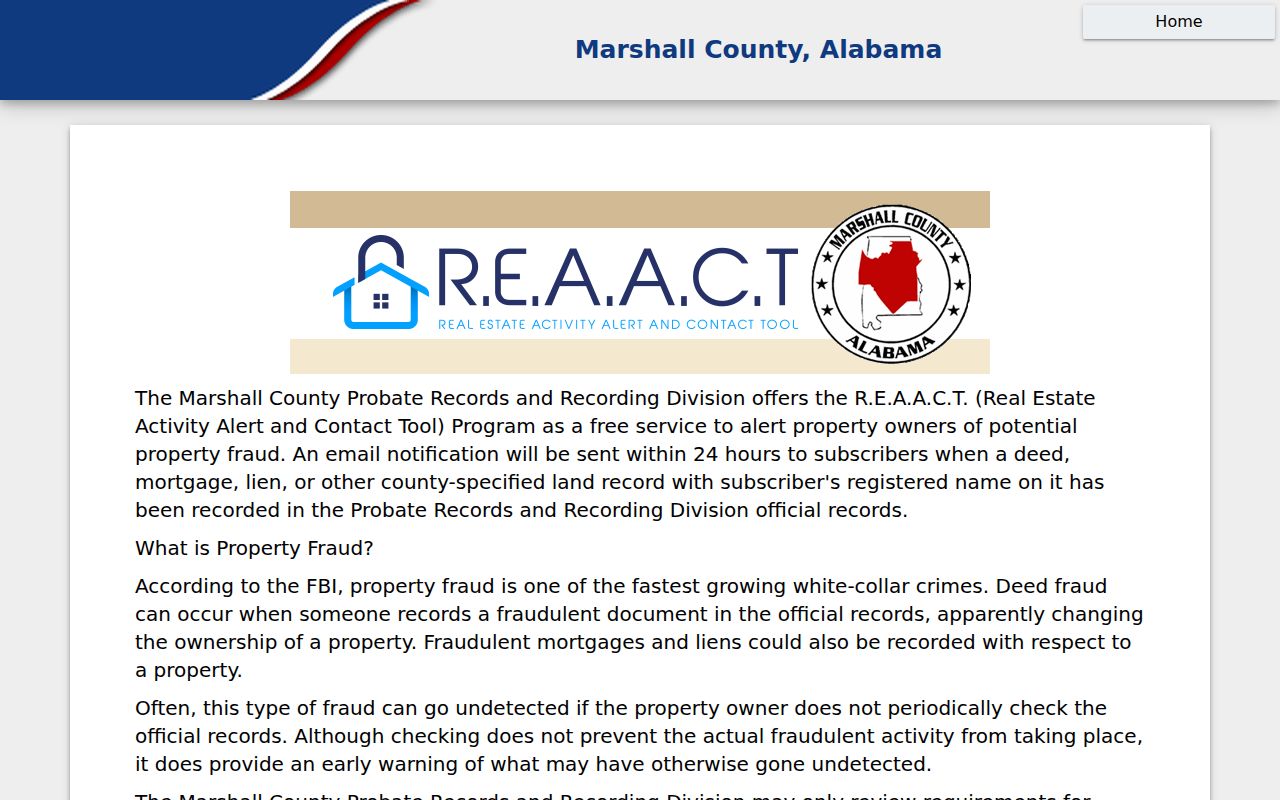
Treat the alert as a starting point for fraud monitoring. It is not proof that an instrument is false. A compliant document may be recorded even if later disputed. The Recorder cannot reverse it without a judge's order. Open the actual instrument. Compare the name and parcel, then report suspected fraud through the stated legal channels.